Why Touch a Hotel Mirror Before Unpacking? [important Information]
The “fingertip test” is a simple, effective security hack every traveler should know. By touching the glass of a hotel mirror, you can quickly determine if it is a standard surface or a potentially intrusive two-way mirror. This quick habit ensures your privacy remains protected the moment you step into your room.
We have all been there. You have spent hours traveling, you are tired, and all you want to do is drop your bags and collapse on the bed. It is tempting to just walk into your hotel room, toss your suitcase on the floor, and start relaxing. However, there is one small, incredibly quick habit that travel experts swear by before you settle in for the night. You should always make sure you touch a hotel mirror before unpacking.
It sounds a bit like something from a spy movie, doesn’t it? Many people laugh at the idea of checking mirrors, thinking it is an urban legend from the early days of the internet. Yet, in 2026, privacy is more valuable than ever. While the vast majority of hotels are safe and trustworthy, taking ten seconds to perform this simple check gives you absolute peace of mind. It turns your hotel room into a true sanctuary where you can finally let your guard down.
Key Takeaways
- The Fingertip Test: Simply touch the glass; if there is a gap between your finger and its reflection, it is likely a normal mirror.
- Potential Risk: Two-way mirrors allow someone on the other side to see through, posing a serious privacy threat.
- Context Matters: While rare in reputable hotels, checking mirrors is a smart precaution for peace of mind.
- Beyond Mirrors: Keep an eye out for odd room placements or unusual objects that seem out of place.
- Trust Your Gut: If a room feels “off” or you suspect tampering, contact hotel management immediately.
Understanding the Mirror Trick
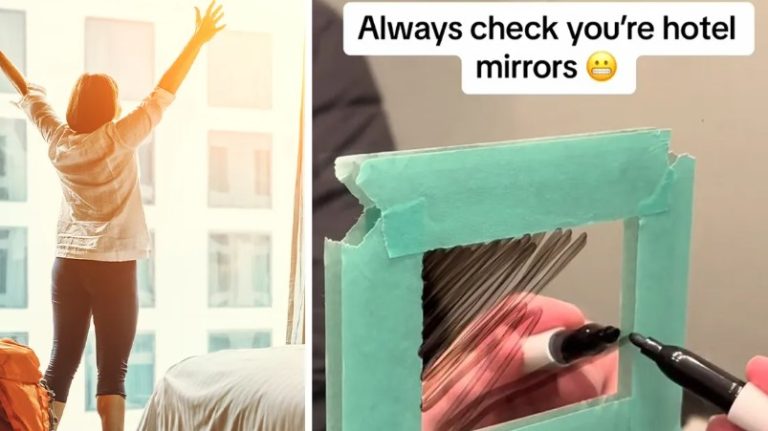
Why touch a hotel mirror before unpacking? The reason is simple: you want to verify that the mirror is just a regular piece of glass. In rare cases, some mirrors are actually two-way mirrors. This means they are coated with a semi-transparent film that allows someone on the other side to see into your room, while you only see your own reflection.
How the Fingertip Test Works
The science behind this trick is based on basic physics. In a normal wall-mounted mirror, there is a layer of glass, then a layer of silvering (the reflective backing) behind it. When you place your finger against the glass, there is a small physical distance between your actual finger and the reflection. You will see a tiny gap of space.
If you are looking at a two-way mirror, the reflective surface is often on the front or integrated differently. When you touch it, your finger will appear to touch its reflection directly, without any gap. If your fingertip feels like it is touching your actual skin, it is a red flag. While this test is not foolproof, it is a great first indicator that something might be wrong.
When Should You Be Concerned?
It is important to keep things in perspective. You do not need to walk into every hotel room acting like a secret agent. The hospitality industry has rigorous standards, and reputable chains prioritize guest safety above all else. However, there are scenarios where extra caution is helpful.
Visual guide about Why Touch a Hotel Mirror Before Unpacking
Image source: i.ytimg.com
High-Risk Environments
If you are staying at a budget motel, a rental property in a remote area, or an unverified short-term rental, it is wise to be more observant. These types of accommodations sometimes have less oversight than large hotel chains. If you feel like the room layout is strange—for example, if a mirror is placed in an odd spot like directly opposite a bed or in a bathroom with an unusually thick wall—take the extra second to inspect it.
Additionally, if you notice the mirror seems loose, has exposed wires, or if the mounting hardware looks tampered with, trust your instincts. Most of the time, it is just an old mirror, but if your gut says something is wrong, listening to that feeling is never a bad move.
Other Security Checks for Your Room
Once you have decided why touch a hotel mirror before unpacking is a good safety habit, you might wonder what else you should check. While the mirror is a classic, there are other spots in a room that seasoned travelers check to ensure their privacy.
Inspecting Electronics and Décor
In 2026, hidden cameras have become smaller and more advanced. While rare, they are occasionally hidden inside common objects. Keep an eye out for smoke detectors that look slightly off-center, strange power bricks plugged into outlets, or alarm clocks that seem to have extra lenses. You don’t need to dismantle the room, but a quick visual scan is helpful.
Check the curtains as well. Ensure they close completely without gaps that could allow someone outside to peek in. If the room has a connecting door to another room, ensure the latch is secure and that it cannot be opened from the other side. These small, simple steps go a long way in making sure your stay is private.
Why Reputation and Reviews Matter
The best way to avoid having to worry about these things is to choose where you stay carefully. Before you book, look at reviews from the last few months. If guests mention anything about feeling unsafe, hidden cameras, or strange room features, you should probably look elsewhere. Platforms in 2026 make it easier than ever to filter through feedback and find reliable, safe accommodations.
Communicating with Staff
If you do happen to find something suspicious, do not just leave it alone. Contact the hotel front desk immediately. If they cannot explain why an object is there or if they seem evasive, do not hesitate to ask for a new room or to check out and find a different hotel. Your safety is worth far more than the inconvenience of moving. Always remember: you have the right to feel secure in the space you are paying for.
The Psychological Benefit of Caution
Beyond the physical safety aspect, performing these checks has a massive benefit for your mental state. Traveling can be stressful. You are in a new place, often with a different schedule and environment. By taking a moment to “sweep” your room and verify your space, you transition from a state of travel anxiety to a state of relaxation.
Building Your Personal Travel Routine
When you start to wonder why touch a hotel mirror before unpacking, you realize it is just one part of a larger travel ritual. Creating a routine—like checking the door lock, looking at the window, and tapping the mirror—helps you own your space. It turns a temporary room into a home base where you can truly rest. When you know you have taken these basic precautions, you can stop worrying about the environment and start focusing on your trip.
Final Thoughts on Travel Safety
The world is a big, exciting place, and the risks of encountering a two-way mirror or a hidden camera are incredibly low for the average traveler. However, “low risk” does not mean “zero risk.” By understanding why touch a hotel mirror before unpacking, you are simply adding one more tool to your safety kit. It is not about living in fear; it is about living with awareness.
So, the next time you drop your bags, take that ten-second detour to the mirror. Run your finger against the glass, enjoy the reflection, and then get on with your trip. Stay smart, stay observant, and enjoy your travels to the fullest in 2026 and beyond. You deserve to feel comfortable and secure wherever you choose to lay your head.
Frequently Asked Questions
Is the fingertip test 100% accurate?
While the fingertip test is a great quick-check method, it is not scientifically foolproof. It is intended as a basic security indicator to give you an immediate sense of the mirror’s construction.
How common are two-way mirrors in hotels?
Two-way mirrors are extremely rare in reputable hotels and established lodging chains. They are more likely to be a concern in unverified, private rentals or sketchy, unregulated properties.
What should I do if I find a two-way mirror?
If you truly believe a mirror is two-way, immediately leave the room, take your belongings with you, and notify the hotel management or local authorities. Do not stay in the room if you feel your privacy is compromised.
Should I check for hidden cameras too?
A quick visual scan of the room for out-of-place objects is a smart habit for any traveler. While high-tech security is rare, staying aware of your surroundings is always a good practice.
Does the mirror trick work with all types of mirrors?
The gap test works best on standard wall-mounted mirrors where there is a clear physical layer of glass. Different types of reflective surfaces might behave slightly differently, but the gap principle remains the most reliable indicator.
Is it paranoid to check hotel mirrors?
Not at all! Many seasoned travelers consider it a standard part of their room-settling ritual. It takes seconds to do and provides significant peace of mind, allowing you to relax more fully during your stay.