How Does a Mirror Work? [Read To Know Full details]
Ever looked into your bathroom glass and wondered, how does a mirror work? At its core, a mirror reflects light using a smooth glass pane backed by a thin layer of reflective metal, usually silver or aluminum. When light rays hit this surface, they bounce back at the exact same angle they arrived, creating a clear and accurate visual copy of the world in front of it.
Think about how many times a day you look into a mirror. You check your hair, brush your teeth, or catch a quick glance of yourself walking down the hall. It feels completely natural, almost like magic. But have you ever paused to ask yourself, how does a mirror work?
It is one of those everyday mysteries we rarely stop to investigate. We just accept that glass can magically show us a duplicate version of reality. Behind that simple reflection, however, lies an incredible mix of physics, chemistry, and the behavior of light. By understanding how light interacts with materials, you can finally unlock the secret behind your daily reflection.
Key Takeaways
- The Basic Concept: A standard mirror is made of a transparent glass sheet with a reflective metallic coating on the back.
- Law of Reflection: Mirrors work because light bounces off the reflective surface at the exact same angle that it hits.
- Specular vs. Diffuse: Smooth mirrors create clear reflections, unlike rough surfaces that scatter light in all directions.
- The Glass Layer: The glass protects the delicate metal backing from damage, scratches, and tarnishing.
- Left-Right Reversal: Mirrors do not actually flip images left-to-right; they reverse them front-to-back along the axis of depth.
- Historical Evolution: Ancient mirrors were made of polished obsidian or bronze before modern glass and silvering techniques were invented.
The Anatomy of a Modern Mirror
To understand how a mirror works, we first need to look at what is actually inside one. If you were to slice a modern bathroom mirror in half, you would not just see solid metal. Instead, you would see a clever sandwich of materials designed to capture and bounce light.
The Glass Pane
The front layer of a standard mirror is simply a flat, transparent sheet of glass. The main job of this glass is to protect the delicate layer behind it. Good quality mirrors use very clear glass with low iron content, ensuring that the glass itself does not tint or distort your reflection with a greenish hue.
The Reflective Coating
Directly behind the glass lies the real secret to the reflection: a microscopic layer of metal. For centuries, mirror makers used mercury or silver. Today, manufacturers typically use a very thin layer of vaporized aluminum or silver. This metallic film is applied directly to the back of the glass, acting as the ultimate light-stopper. Without this metal backing, the glass would just be a window that lets light pass right through.
The Protective Paint
Because metals like silver and aluminum are fragile and prone to oxidation when exposed to air, the metal layer gets coated with a durable, dark paint. This paint protects the reflective coating from scratches, moisture, and general wear and tear, ensuring your mirror lasts for years.
The Physics of Light Reflection
Now that we know what a mirror is made of, let us talk about the physics. The entire process relies on how light travels and behaves when it hits a solid object. When you look at an object, you are not actually seeing the object itself; you are seeing the light that bounces off of it and travels into your eyes.
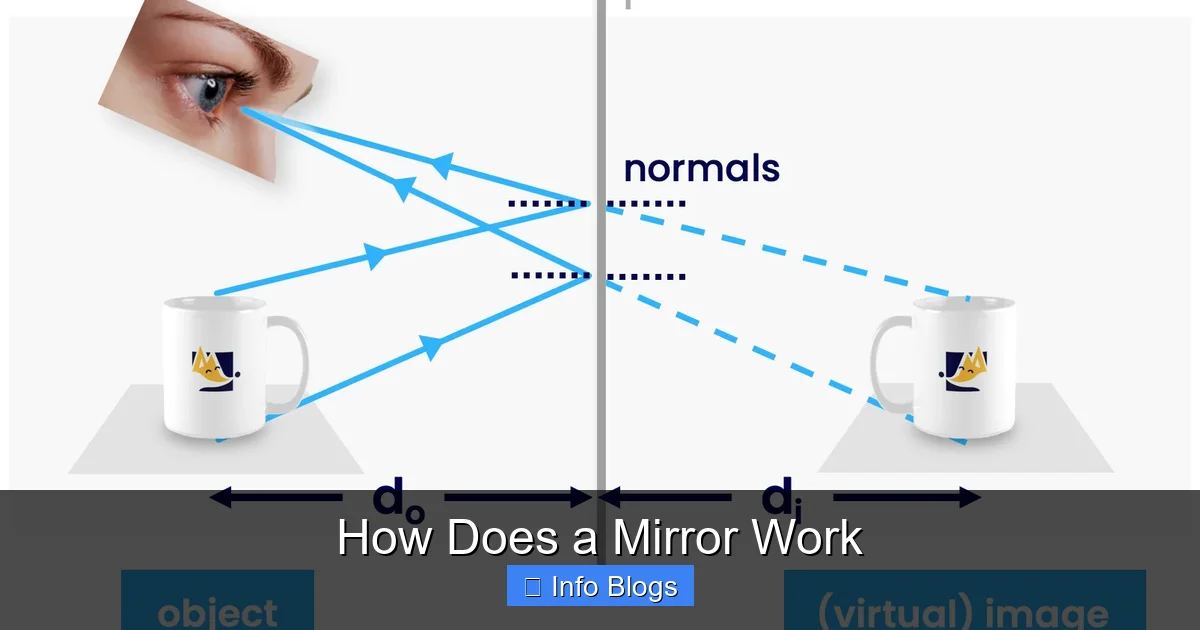
Visual guide about How Does a Mirror Work
Image source: physicsfox.org
Light Waves in Action
Light travels in straight lines called rays. When you stand in front of a mirror, light bulbs or the sun shine light onto your body. That light bounces off your shirt, your face, and your hair, traveling outward in every possible direction. Some of those light rays travel straight toward the mirror.
The Law of Reflection
When the light rays hit the glass, they pass right through it until they reach the metal backing at the back of the mirror. Because the metal atoms are packed tightly together with free-moving electrons, they refuse to let the light pass through. Instead, they absorb the light energy and immediately re-emit it. This process is called specular reflection. The light bounces off the metal at the exact same angle that it hit the surface. Physicists call this the Law of Reflection: the angle of incidence equals the angle of reflection.
Why Mirrors Reflect While Walls Do Not
A common question people ask when learning how a mirror works is: why does a mirror reflect a clear image while a painted wall, which also has light bouncing off it, does not?
Smooth Surfaces vs. Rough Surfaces
The secret comes down to texture. To your naked eye, a painted wall might feel relatively smooth. On a microscopic level, however, a painted wall is bumpy, jagged, and uneven. When parallel light rays hit a rough wall, they scatter in millions of random directions. This is called diffuse reflection, and it prevents any clear image from forming.
Microscopic Smoothness
A mirror, on the other hand, is polished to an astonishing degree of microscopic smoothness. Because the surface is so flat and uniform, the light rays hit it and bounce off in an organized, parallel pattern. Your brain processes this orderly bounce of light as an exact visual replica of the room and objects in front of the mirror.
The Mystery of Left-Right Reversal
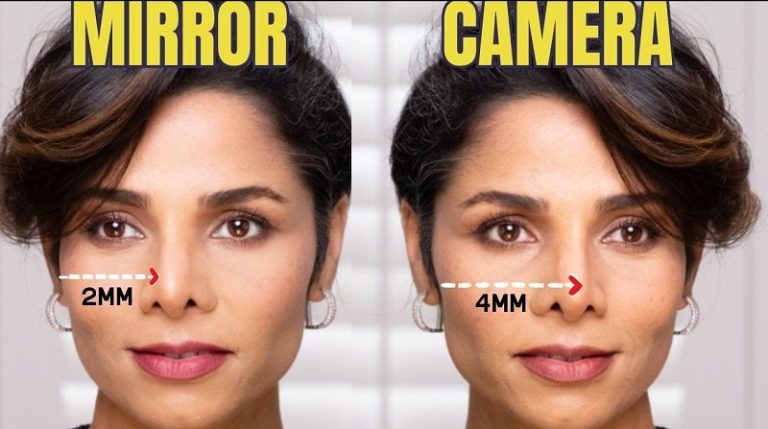
One of the most mind-bending aspects of mirrors is how they seem to flip things. If you raise your right hand, your reflection raises its left hand. Why does a mirror flip things horizontally, but it never seems to flip them upside down?
It Is Actually Front-to-Back
Here is a fun fact: mirrors do not actually flip things left-to-right at all. They flip things front-to-back! Imagine pressing your hand against the glass. The part of your hand touching the glass is the front. In the reflection, the front of your hand is still facing the glass, but the image is reversed along the depth axis. You are the one who mentally rotates the image 180 degrees to imagine yourself stepping through the looking glass, which creates the illusion of a left-to-right swap.
Try holding up a piece of paper with text on it in front of a mirror. You will notice that the words are reversed. That is because the light from the left side of the paper traveled to the left side of the mirror and bounced straight back to your eyes, preserving its relative position.
Practical Tips for Choosing and Placing Mirrors
Now that you are an expert on how does a mirror work, you can use this knowledge to your advantage in everyday life. Whether you are decorating your home or trying to make a small room feel bigger, physics can guide your choices.
Make Small Spaces Feel Larger
Because mirrors duplicate light and images, placing a large mirror opposite a window will bounce natural sunlight back into the room. This tricks your brain into perceiving twice as much space and light, making cramped apartments feel bright and airy.
Clean Your Mirrors Correctly
Since reflection relies entirely on a smooth, clean surface, smudges, dust, and grime can scatter light and ruin a reflection. Use a microfiber cloth and a gentle glass cleaner to wipe your mirrors without scratching the delicate glass surface.
By understanding the science of light, glass, and metal, the humble mirror transforms from a simple household item into a brilliant marvel of physics. The next time you catch your reflection, you will know exactly what is happening behind the glass!
Conclusion
So, how does a mirror work? It is truly a wonderful combination of simple physics and clever chemistry. By pairing a smooth pane of protective glass with a microscopic layer of reflective metal, we can bend and bounce light rays to create a crisp, accurate reflection of our world. Whether you are admiring your outfit or using a mirror to brighten up a dark hallway, you are interacting with the fascinating laws of optics every single day.
Frequently Asked Questions
How does a mirror work scientifically?
A mirror works through the law of reflection, where light hits a smooth metallic coating behind a glass sheet and bounces back at the exact same angle it arrived.
Why are mirrors coated with silver or aluminum?
Metals like silver and aluminum have free-moving electrons that absorb and re-emit light photons very efficiently, creating a crisp and bright reflection instead of letting light pass through.
Why do mirrors flip things left to right?
Mirrors do not actually reverse images horizontally; they reverse them front-to-back along the depth axis, and our brains interpret this as a left-to-right flip.
Why is the metal on the back of the mirror instead of the front?
Placing the reflective metal on the back protects the delicate coating from scratches, dust, moisture, and oxidation, ensuring the mirror lasts much longer.
Why does a painted wall not act like a mirror?
Painted walls have microscopic bumps that scatter light in all directions through diffuse reflection, whereas mirrors have ultra-smooth surfaces that reflect light in an organized pattern.
Who invented the first modern mirror?
German chemist Justus von Liebig invented the process of coating glass with metallic silver in 1835, which paved the way for the safe and affordable mirrors we use today.