What Is the Mirror Formula for Curved Mirrors?
What is the mirror formula for curved mirrors? It is a fundamental mathematical equation in physics that connects the object distance, image distance, and focal length of spherical mirrors. By understanding this core concept, you can easily predict where an image will form, whether it will be real or virtual, and how big it will appear.
Have you ever looked into a shiny spoon and noticed how your reflection flips upside down on one side and right-side up on the other? Or have you ever wondered how dentists manage to see the tiny details of your back molars using a small angled tool? These everyday optical tricks are governed by the exact same laws of physics. At the heart of these phenomena lies a simple yet powerful equation.
If you are studying optics, you have likely asked yourself, what is the mirror formula for curved mirrors? It sounds like a complex mathematical riddle straight out of a textbook. However, once you break it down into everyday terms, it becomes a fascinating tool for understanding how light bounces off curved surfaces. Let us dive in and explore this essential physics concept together without any complicated jargon getting in the way.
Key Takeaways
- The Core Equation: The mirror formula is expressed mathematically as 1/f = 1/v + 1/u, linking focal length, image distance, and object distance.
- Universal Application: This formula works for both concave and convex mirrors when you apply the correct sign conventions.
- Sign Convention Rules: Distances measured against the direction of incident light are negative, while distances measured in the direction of light are positive.
- Focal Length Relationship: The focal length (f) is always half of the radius of curvature (R) for any given spherical mirror.
- Magnification Link: The mirror formula pairs closely with the linear magnification formula to determine the size and orientation of the formed image.
- Real vs. Virtual: Real images have a positive image distance, while virtual images formed behind the mirror have a negative image distance.
Understanding the Basics of Curved Mirrors
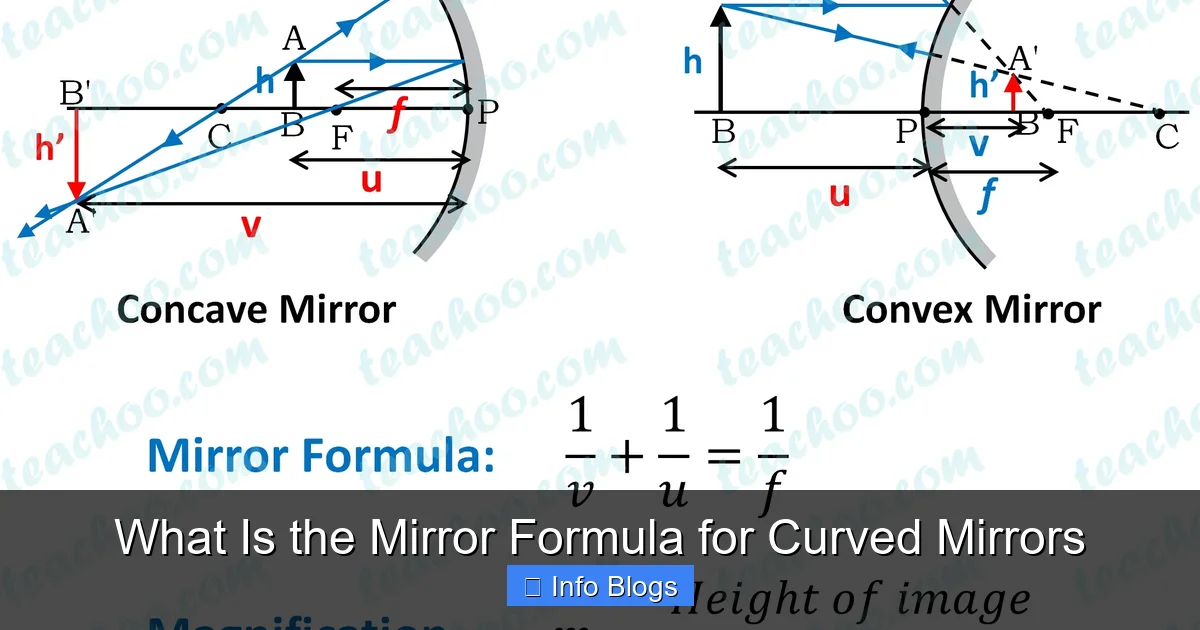
Before we jump straight into the math, we need to picture what a curved mirror actually is. Think of a spherical mirror as a tiny slice taken out of a hollow glass sphere. If the inner surface of that slice is polished and reflective, we call it a concave mirror. If the outer bulging surface is reflective, we call it a convex mirror.
Key Terms You Need to Know
To master the mirror formula, you must first get comfortable with a few basic vocabulary words. The pole of the mirror is the exact center of the reflective surface. The center of curvature is the center of the imaginary sphere that the mirror was sliced from. The principal axis is an imaginary straight line drawn right through the pole and the center of curvature.
Finally, we have the principal focus. This is the magical spot where light rays parallel to the principal axis either converge or appear to diverge from after bouncing off the mirror. The distance between the pole and this focus is known as the focal length. Once you can picture these points, you are ready to tackle the math.
What Is the Mirror Formula for Curved Mirrors?
So, what is the mirror formula for curved mirrors in its purest form? Simply put, it is an algebraic equation that connects three critical distances in any reflection scenario. Those three distances are the object distance, the image distance, and the focal length.
The Equation Revealed
The standard equation you will see in every physics classroom around the world is written as follows:
1 / f = 1 / v + 1 / u
Let us break down what each of these letters actually represents in the real world:
- f: The focal length of the mirror, measured from the pole to the principal focus.
- v: The image distance, which is how far the formed image is from the pole of the mirror.
- u: The object distance, which is how far the actual physical object is placed from the pole of the mirror.
This tidy little fraction equation allows physicists and engineers to calculate missing variables instantly. If you know where an object stands and you know the focal length of your mirror, you can figure out precisely where the image will pop into existence.
The New Cartesian Sign Convention
If you want to use the mirror formula correctly every single time, you cannot ignore the sign conventions. Without these rules, your math will lead you astray, and your calculated image locations will not match reality.
Rules for Measuring Distances
Think of the pole of the mirror as the zero point on a standard graph, much like the origin on an X-Y coordinate plane. Here are the golden rules to keep in your back pocket:
- All distances must be measured starting from the pole of the mirror along the principal axis.
- Any distance measured in the same direction as the incoming light is considered positive.
- Any distance measured in the opposite direction of the incoming light is considered negative.
- Heights measured upward above the principal axis are positive.
- Heights measured downward below the principal axis are negative.
For a standard concave mirror where the light comes from the left and hits the mirror facing left, the object distance is almost always negative. This is because you measure from the pole to the left to reach the object. Keeping these positive and negative signs straight is the number one trick to nailing your physics homework problems.
Connecting the Mirror Formula to Magnification
Knowing where an image forms is only half the battle. You also want to know how big or small that image will be. That is where linear magnification comes into play to complement the mirror formula.
Understanding Magnification
Magnification tells us the ratio of the height of the image to the height of the object. We can also calculate it using the object and image distances. The standard formula for magnification (m) looks like this:
m = Height of Image / Height of Object = -v / u
If your magnification value comes out positive, it means the image is virtual and upright. If the value is negative, the image is real and inverted. If the absolute value of m is greater than one, your image is bigger than the object. If it is less than one, the image is smaller.
Practical Examples and Real-World Uses
Physics is always more fun when we see how it applies to our daily lives. Curved mirrors are everywhere, and the mirror formula helps engineers design them for maximum effectiveness.
Everyday Applications
Consider the side-view mirror on the passenger side of your car. That is a convex mirror, famous for stamping the warning that objects in the mirror are closer than they appear. Because it diverges light, it always creates a diminished, virtual image, giving the driver a wider field of view.
On the flip side, makeup mirrors and shaving mirrors are concave. If you hold your face close to a concave mirror, it acts as a magnifying glass, projecting a larger virtual image of your skin. Astronomers also use massive concave mirrors in reflecting telescopes to capture faint light from distant stars and focus it onto a tiny sensor.
Conclusion
To wrap things up, answering what is the mirror formula for curved mirrors gives you a powerful window into the behavior of light. By memorizing the simple fraction equation 1/f = 1/v + 1/u, respecting the Cartesian sign conventions, and pairing your findings with the magnification formula, you can solve almost any reflection problem thrown your way.
Whether you are designing a high-tech optical device or simply trying to ace your upcoming science quiz, these fundamental principles remain unchanged. Keep practicing with different numbers, pay close attention to your plus and minus signs, and you will find that optics is not nearly as intimidating as it first appears.
Frequently Asked Questions
What is the mirror formula used for in physics?
The mirror formula is used to calculate the focal length, image distance, or object distance for spherical mirrors. It allows scientists and students to predict the exact location where an image will form.
Does the mirror formula work for both concave and convex mirrors?
Yes, the formula applies to both types of curved mirrors. You simply need to apply the correct sign conventions for focal length and distances depending on the mirror type.
What does a negative image distance mean?
A negative image distance means that the image is virtual and located behind the mirror. Virtual images cannot be projected onto a physical screen.
How is focal length related to the radius of curvature?
The focal length of any spherical mirror is always exactly half of its radius of curvature. This relationship is written mathematically as f = R / 2.
Why are sign conventions so important in mirror formula problems?
Sign conventions tell you the orientation and position of the object and image relative to the mirror pole. Without them, your calculations will not accurately reflect real-world physics.
Can the mirror formula be used for flat plane mirrors?
Technically yes, because a plane mirror can be thought of as a sphere with an infinite radius. In a plane mirror, the object distance always equals the negative of the image distance.