How Do One Way Mirrors Work? [Everything You Need To Know]
Ever wondered how do one way mirrors work in police interrogation rooms and spy movies? The secret is not magic, but a clever trick of physics involving specialized metallic coatings and careful lighting. By balancing the amount of light on each side of the glass, a one-way mirror acts as a reflective surface to one person and a transparent window to another.
Picture this classic scene from a crime thriller: two detectives stand in a brightly lit room, staring intensely through a large glass window at a suspect in the next room. The suspect looks into the same glass and sees only their own reflection to fix their hair or wipe away sweat. They have no idea they are being watched. It is a dramatic trope that has entertained us for decades, but it also sparks a very real curiosity about the science behind it.
Have you ever asked yourself, how do one way mirrors work? It feels a bit like a magic trick. After all, how can a piece of glass act like a solid mirror on one side and a plain window on the other? As it turns out, the answer involves a fascinating blend of chemistry, physics, and human psychology. There are no secret trapdoors or one-way light particles involved. Instead, the secret lies entirely in how light behaves and how our eyes perceive it.
Key Takeaways
- The Core Illusion: One-way mirrors do not actually send light in only one direction; they reflect some light and let some light pass through equally in both directions.
- The Role of Lighting: The illusion only works because one side of the glass is brightly lit while the other side is kept very dark.
- Metallic Coatings: A thin, semi-reflective layer of aluminum or other metals is applied to the glass to create the dual reflective and transparent effect.
- Not True Physics Defiance: Light travels both ways through the glass, but our eyes and brains are tricked by the contrast in ambient light levels.
- Everyday Examples: You can see this effect yourself when looking out a bright window at night or wearing mirrored sunglasses.
- Practical Adjustments: If lighting conditions change on either side of a one-way mirror, the illusion breaks down, and people on both sides can see through it.
The Basic Physics of Glass and Light
To truly understand how do one way mirrors work, we first need to look at how ordinary glass interacts with light. When light hits any transparent pane of glass, three things happen to those light waves simultaneously. Some of the light bounces off the surface, some of the light passes right through to the other side, and a tiny bit of the light gets absorbed by the glass material itself.
Reflecting Versus Transmitting Light
Normal window glass is designed to transmit as much light as possible so you can see outside. A regular mirror, on the other hand, is designed to reflect almost all the light that hits it by using a solid, opaque backing behind the glass. A one-way mirror—known scientifically as a two-way mirror—sits right in the middle of these two extremes. It is designed to do both jobs at the exact same time.
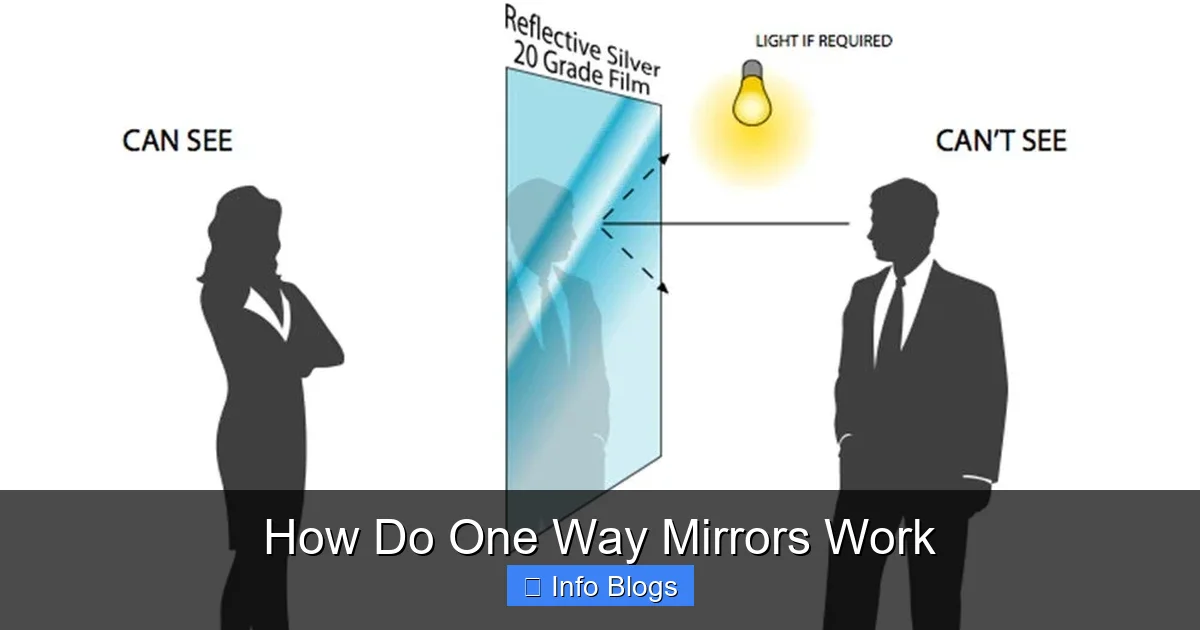
When light hits a one-way mirror, about half of the light bounces back toward the source, while the other half passes straight through to the other side. If the glass transmits and reflects light equally in both directions, why can people on one side see through it while people on the other side cannot? The answer is all about the environment.
The Magic Ingredient: The Metallic Coating
If you were to use a plain piece of window glass, you would not get a convincing one-way mirror effect. The secret ingredient that makes this optical illusion possible is a very thin, specialized coating applied to one side of the glass.
Aluminum and Silver Films
Manufacturers create this special glass by applying a microscopic, semi-reflective film to the surface. This film is often made of a very thin layer of aluminum, silver, or other metallic alloys. The layer is so thin that engineers call it a half-silvered surface.
Because the coating is so thin, it does not block all the light. Instead, it lets roughly half of the light pass through while reflecting the other half. If you looked at this coated glass on its own in an open room with equal lighting on both sides, it would simply look like a slightly tinted, hazy window. You would be able to see through it in both directions, though the view might look a bit dim.
The Crucial Role of Lighting
This brings us to the most important part of the puzzle. When people ask, how do one way mirrors work, they often forget that the glass itself is only half the equation. The environment surrounding the glass is what actually makes the illusion succeed or fail.
The Bright Room vs. The Dark Room
To make a one-way mirror function properly, you need two distinct lighting conditions: one side must be very brightly lit, and the other side must be kept very dark. Let us walk through what happens to the light on both sides of the glass.
On the bright side of the glass—the observation room—there is a lot of ambient light. This bright light hits the glass and bounces off the metallic coating in large amounts. When the people in the bright room look at the glass, the light reflecting off their side is so intense and overwhelming that it completely drowns out any light trying to pass through from the dark room.
On the dark side of the glass—the interrogation room—there is very little light. The few light rays that manage to pass through the glass from the bright room are easily visible to the person in the dark room. Meanwhile, the person in the dark room produces very little light of their own. When they look at the glass, the metallic coating reflects back that tiny amount of their own dim light, creating a clear mirror image.
Everyday Examples of the Effect
You have likely experienced this exact same phenomenon in your daily life without even realizing it. The physics behind one-way mirrors happen naturally all around us in the world.
Car Windows and Office Buildings
Think about driving your car on a bright, sunny afternoon. If you look at the windows of another car or a modern office building, you will often see a shiny, mirrored surface reflecting the sky and the trees. However, the people sitting inside those cars or offices can look right out at you without any trouble.
This happens because the outside world is bathed in bright sunlight, making the exterior glass act like a mirror. Inside the car or building, it is relatively dim, so the people inside can see through the glass just fine. At night, this effect completely reverses. If you turn on the interior lights of your car or house at night, people outside can easily look inside, while you might struggle to see past your own reflection in the window.
What Happens When the Illusion Fails?
Because the illusion relies entirely on a delicate balance of light, it can easily break down if the lighting conditions change. This is a crucial safety and privacy detail for anyone using these mirrors.
The Importance of Lighting Balance
If someone in the dark room suddenly turns on a bright overhead light, the one-way mirror stops working instantly. Suddenly, there is plenty of light on the dark side to bounce off the glass and travel back into the observation room. The people in the observation room will no longer see a reflection; instead, they will be able to see right into the formerly dark room.
This is why interrogation rooms always have strict rules about lighting. If a detective accidentally turns on a desk lamp on the wrong side of the glass, the suspect on the other side will suddenly realize they are being watched. Next time you watch a movie with a tense one-way mirror scene, pay attention to the lighting. You will notice the filmmakers always keep the viewing side dark and the subject side bright to keep the illusion alive.
Understanding how do one way mirrors work gives us a great appreciation for how easily our eyes and brains can be tricked. By combining a clever semi-reflective metallic coating with a smart difference in lighting, a simple pane of glass transforms into a window of opportunity for detectives, psychologists, and curious minds alike.
Frequently Asked Questions
Are one-way mirrors truly one-way?
No, light actually travels in both directions through the glass equally. The glass reflects some light and lets some light pass through no matter which side it hits.
Can you see through a one-way mirror from the dark side?
Yes, people standing on the dark side can see through the glass into the bright room because light from the bright side passes through to them.
What is applied to the glass to make it work?
Manufacturers apply a very thin, microscopic layer of metal, such as aluminum or silver, which creates a semi-reflective surface.
Why do one-way mirrors fail at night?
At night, if the light inside a room is brighter than the light outside, the glass reflects the interior light back, making it act like a mirror from the inside.
Are mirrored sunglasses a type of one-way mirror?
Yes, mirrored sunglasses use the same basic principle. The bright sunlight reflects off the outside coating, hiding your eyes, while you can see out clearly because your face is in shadow.
Do police interrogation rooms use real one-way mirrors?
Yes, they use specialized glass with proper lighting controls, though modern setups sometimes use digital video cameras instead for better recording quality.